
Key Takeaways
- Scientists are tweaking an unusual metal oxide, creating super-thin layers.
- They’ve noticed it shows signs of magnetism when you squish or stretch its atomic structure.
- This isn’t your fridge magnet; we’re talking about induced magnetism, a tricky business.
- Potential uses could be wild: next-gen data storage, maybe even spintronics, but it’s *way* early.
The Story
Alright, folks, gather ’round. We’ve got another one of those headlines that makes your inner geek do a little jig, then your pragmatic brain kicks in with a hefty dose of side-eye. You know the drill. “Scientists discover amazing thing in lab!” Yeah, yeah. But here’s the kicker: this time, it involves an “unusual metal oxide” getting all magnetic when you literally strain its tiny little atomic structure. In ultrathin layers, no less. Sounds like sci-fi, doesn’t it?
For starters, let’s break it down. We’re talking about some clever folks in white coats taking a material that, on its own, isn’t exactly a magnet. Think of it like a piece of wood. Not magnetic, right? But what if you could take a super-thin slice of that wood, stretch it just so, and suddenly it had a magnetic field? That’s kinda what we’re looking at here, but with a fancy, not-so-ordinary metal oxide. It’s subtle, it’s specific, and it’s happening at a scale we can barely wrap our heads around.
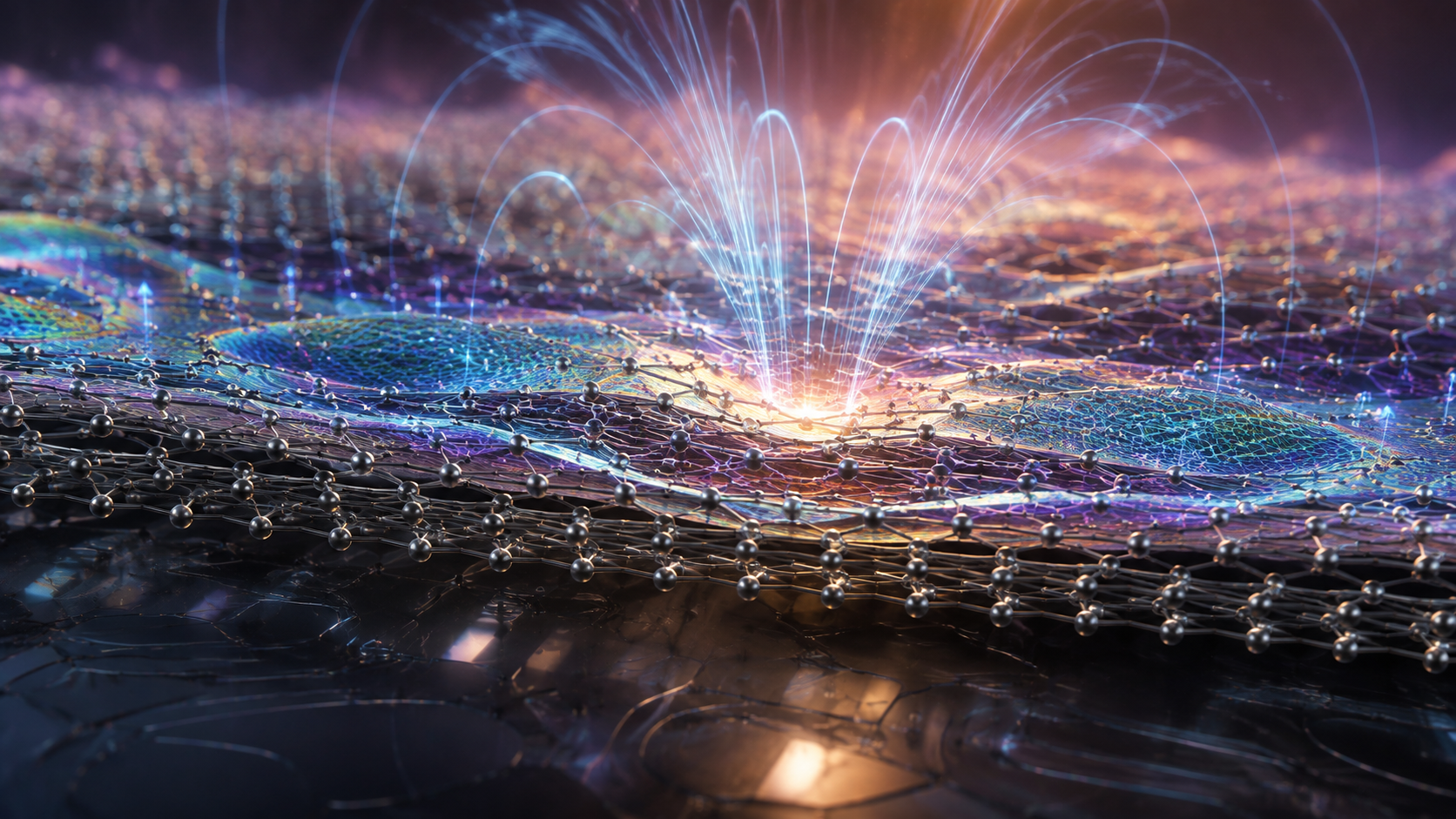
The trick? It’s all about “lattice strain.” Imagine those atoms forming a perfectly neat grid. Now, picture gently pulling that grid apart or pushing it together. This slight distortion, this “strain,” is what apparently flips a switch and gets the electrons inside this oxide to align in a way that generates magnetism. It’s like coaxing a shy kid to perform by promising them ice cream. The right conditions, the right motivation, and boom! You’ve got magnetism where there wasn’t any before. It’s a neat parlor trick, if nothing else.
And when we say “ultrathin layers,” we’re not messing around. We’re talking about materials just a few atoms thick. Seriously. Building these things is like trying to stack playing cards on a windy day, blindfolded. It’s a testament to incredible precision and a whole lot of expensive equipment. These aren’t chunks you can pick up at Home Depot. Not yet, anyway.
Pros & Cons / Feature Comparison
Let’s weigh what this could mean, both the shiny promise and the gritty reality.
- Pros:
- On-demand magnetism: Imagine materials that are only magnetic when you *want* them to be. Huge for energy efficiency.
- New data storage potential: Magnetic storage is old news, but dynamic magnetism? That’s a whole different ballgame. Could lead to denser, faster storage.
- Spintronics applications: This is where things get really wild. If you can control electron spin with strain, you’re looking at a new paradigm for computing, potentially faster and more powerful than current electronics.
- Materials science breakthroughs: Understanding how strain induces magnetism opens up a lot of doors for engineering other novel materials.
- Smaller devices: Ultrathin layers mean tiny components. Think even smaller, more integrated electronics.
- Cons:
- Fragile as heck: Ultrathin layers and precise strain? One wrong move and you’ve got useless expensive dust.
- Scalability nightmare: Producing this stuff for actual products? We’re a long, long way from doing that affordably or efficiently at scale.
- Lab conditions only (for now): Generating and maintaining that precise lattice strain isn’t something you can easily do outside a research facility. What about real-world temperatures? Vibrations? Forget about it.
- Weak magnetism: “Signs of magnetism” isn’t “strong enough to levitate a car.” It’s likely very subtle, requiring sensitive detection.
- Cost: Cutting-edge materials research isn’t cheap. The cost to produce even a small amount would be astronomical right now.
- The “unusual” oxide factor: Is this material rare? Toxic? Hard to source? We don’t know, and that matters for commercial viability.
Why This Matters
Okay, so it’s a lab curiosity, right? Why should we even bother? Here’s the thing: every big breakthrough starts as a lab curiosity. Think about transistors. They weren’t born fully formed into your iPhone. Someone played with semiconductors, saw something weird, and the rest is history. This metal oxide gig, while certainly not ready for prime time, points to a future where we can engineer material properties on the fly.
Make no mistake, if we can reliably control magnetism with strain, we’re not just tweaking existing tech; we’re creating entirely new categories. Imagine a hard drive that only uses power to store data when it’s actively writing or reading. Or a quantum computer where the qubits are manipulated by physical strain instead of tricky electromagnetic fields. The energy savings alone could be massive. But we’re also talking about a totally different way to think about how information is processed and stored.
The big picture? It’s about pushing the boundaries of what materials can do. It’s about finding that oddball property that unlocks a thousand other innovations. We’re not just looking for a better chip; we’re looking for a fundamentally different kind of chip. This discovery, however nascent, is another tiny step down that path. It’s a reminder that the physical world still holds plenty of secrets, and some of them are pretty mind-bending when you start to prod them with a microscope and a super-precise atomic manipulator. It’s proof that there’s always something new around the corner, even if that corner is in a pristine, vibration-free lab.
Frequently Asked Questions
Q: What exactly is an “unusual metal oxide”? Is it like, radioactive or something?
A: Nah, probably not radioactive. “Unusual” in this context usually means it’s not a common, everyday material. It could be something with a specific crystalline structure or rare element composition that makes it behave uniquely. It’s not your grandma’s rust, that’s for sure. Researchers pick these materials for a reason: they’ve got weird potential.
Q: How do they actually “strain” something that’s only a few atoms thick? Do they use tiny tweezers?
A: Not tweezers, no! We’re talking about extremely precise methods, often involving growing these ultrathin layers on a specific “substrate” material. If the substrate’s atomic spacing is slightly different from the oxide’s natural spacing, it forces the oxide layer to stretch or compress to match, creating that internal “lattice strain.” It’s controlled at an atomic level, super delicate stuff.
Q: So, when can I buy a strain-magnetic hard drive? Next year?
A: Whoa, slow your roll there, bucko. Next year? Not a chance. We’re talking decades, honestly. This is fundamental research. First, they need to make the magnetism stronger and easier to control. Then, they need to figure out how to make it outside a super-clean, super-expensive lab. Then, they need to scale production. We’re a very, very long way from seeing this in commercial products. It’s cool, but it’s future-future tech.
Leave a Reply